Home Page
Search
 
Products > Gold Line > Network Motion Controller - Gold Maestro

Network Motion Controller

The Ultimate Solution for Motion Control Networking

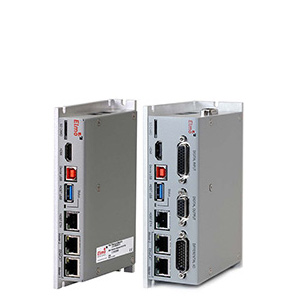
Elmo's Gold Maestro is a network-based, multi-axis machine motion controller designed for industrial applications. It operates in conjunction with both the SimplIQ Line and Gold Line of intelligent digital servo drives to provide a comprehensive and efficient motion control solution for the entire system.
The Gold Maestro is based on the most advanced, easy to use and cost effective distributed motion control architecture which enables the motion processing tasks to be shared between the controller and the drives. It contains a rich feature set that combines sophisticated motion control and advanced communications with full programming capabilities.
The Gold Maestro uses standard protocols over its various communications channels, combined with IEC and C programming and the PLCopen motion interface. The host communication is over an Ethernet or USB network whereas communication with the devices is via EtherCAT or CANopen. Elmo implements protocols “by the book” to enable interoperability with other compatible devices, increase network efficiency and reduce implementation time.


Distributed Network Motion Control System Solutions

Gold Maestro-network-based multi-axis motion Controller

To view in 3D,
click here.

Download eDrawings - 2D CAD Viewer and 3D CAD Viewer and Publisher

  • Gold Maestro Highlights
  • Distributed Motion Control Architecture
  • Intelligence at the Axis Level
  • State-of-the-Art Solutions for Your Machinery
  • Standard Communication Protocols
  • Gold Maestro Functionality
  • Gold Maestro Highlights
    • Top level multi-axis motion controller
    • Upper level (host) communications and protocols:
      • Ethernet, TCP/IP, UDP (Fast Binary Protocols, Modbus, Ethernet/ IP, Telnet, FTP, HTTP)
      • USB 2.0
    • EtherCAT master for distributed networking, with redundancy capabilities and distributed clock management support
    • CANopen master distributed networking.
    • Controls up to 100 axes simultaneously.
    • Distributed intelligence: tasks are split between the Gold Maestro and the SimplIQ and/or Gold Line of servo drives:
      • Significant increase in the motion system’s computation power and performance
      • Simpler high-level motion control interfaces, using the PLCopen standard
      • Faster and better motor control, improved event response times
      • Releases the Gold Maestro’s resources for the machine’s synchronized motion control
      • Reduces the communication load
    • The protocol implementation allows nodes to be easily added, removed and modified.
    • CANopen communication protocols: DS 301, DS 305, DS 401 (I/O Device Profile), DS 402
    • Rich, high-level, multi-axis programming environment:
      • Native 'C' programming using the PLCopen for Motion API
      • IEC 61131-3, PLCopen
      • Large amount of memory
    • Field bus communication
      • EtherCAT
      • CAN bus (isolated)
    • Ready-for-use application program templates for common automation applications.
    • Advanced data recording and "live scope" features, for single and multiple axes
    • Network statistics for diagnostics
    Distributed Motion Control Architecture
    The Gold Maestro's distributed motion control architecture lends itself to an intelligent and modular design of the overall motion control system, enabling optimal selection of the drive for each axis. When coupled with Elmo's family of SimplIQ and Gold Line Network drives, the implementation of the overall motion system is extremely efficient.
    Intelligence at the Axis Level The intelligent servo drives execute the highly demanding local position, velocity, current and vector real-time control algorithms, and they also handle the local axis and I/O sequences using the drive's programming capabilities. Together with a wide variety of special functions and features, Elmo’s drives have very high axis level performance.
    State-of-the-Art Solutions for Your Machinery Needs The Gold Maestro is a state-of-the-art, multi-axis motion controller. Its role is to supervise and synchronize the operation of the overall machine axes and I/Os. Using IEC-61131-3 or C programming, as well as a complete ready-to-use API for PLCopen functions, EtherCAT (or CANopen) master functionality and a wide variety of program templates for common applications, the user can easily create programs for machine control and NC axes synchronization. With up to 100 axes in the system and up to 16 axes in synchronized motion with a cycle time as low as 500 μs and 1 μs accuracy of the overall system distributed clock, the Gold Maestro meets the needs of your application.
    Standard Communication Protocols The Gold Maestro is equipped with Ethernet and USB communication channels to communicate with the host computer, PLC or HMI, and supports standard communication protocols such as Modbus, Telnet, FTP and Ethernet/IP.
    Gold Maestro Functionality
    Operating System
    • Linux, with Elmo’s RT extension for real-time motion control support
    Number of Axes
    • Up to 100 axes, allowing the following types of motion: mixed single axis, multi
    Axis Types
    • Intelligent servo drives support both the SimplIQ and Gold Line product families.
    • Operates in Numeric Control (NC, real-time master synchronization) and non-NC modes.
    • Standard DS 402 drives for CANopen, and DS 402 CoE for EtherCAT.
    Control System Update Rate and Jitter
    • EtherCAT
      • Cycle Update Rate: 500 μs (up to 16 axes can be updated simultaneously at a rate of 500 μs).
      • Drive Cycle Clock Jitter: < 1 μs, based on Master Distributed Clock support, for the full network.
    • CAN
      • Cycle Update Rate: 1 ms (CAN physical network limitations only)
      • Cycle Jitter: < 10 μs for CAN Sync message initiation (actual jitter dependent on the CAN network’s physical
        limitations).
    Supported Motion Modes and Interfaces
    • The Gold Maestro motion interfaces use the PLCopen standard.
    • 64 bit, real-time, double precision profile calculations, allowing full on-the-fly control over speed, acceleration,
      deceleration and jerk.
    • Complex motion schemes, including look-ahead optimizing of trajectory speed calculations for complex
      vector motions.
    • Memory for 1,000 function blocks (a buffer for 1,000 motion segments). Beyond this the buffer is cyclic, so
      there is no practical limit on the buffer size.
    Motion Programming and Debugging
    • Native ‘C’ Programming, running on target. Compiling and debugging. Supplied with the PLCopen Motion Library API.
    • IEC 61131-3 with the PLCopen Motion Library extension using Elmo’s IDE.
      The following languages are supported:
      • Structured text (ST): textual
      • Function block diagram (FBD): graphical
      • Ladder diagram (LD): graphical
      • Sequential function chart (SFC) has elements to organize programs for sequential and parallel control processing
    Programming Execution Time, Threads, and I/O Layer Synchronization
    • Minimal thread resolution timing: 1 ms
    • Number of program execution threads: 10
    • Typical programming execution time (IEC): 10 µs per command.
    • 'C' code programming: Running as native code on the target CPU.
    • I/O layer synchronization timing linked to the master controller sync time (EtherCAT/CAN). I/O level synchronization deterministic over control cycles.
    Communications Hardware
    • Host
    • Ethernet:1 port, Standard Ethernet, 10/100 Mbps, automatically detected.
    • USB: 1 port, USB 2.0, 12 Mbps.
    • RS-232 can be supported in an embedded configuration.
    • Device Networks
    • EtherCAT: 2 EtherCAT master ports, with redundancy support.
    • CAN: CANopen master port.
    Communications Protocols
    • Host
      • Ethernet, TCP-IP/UDP for operational modes
      • Telnet/FTP/HTTP communication for setup and configuration.
      • USB: Using binary protocol (maintenance). Application level: Ethernet-IP/Modbus.
    • Device Network
      • EtherCAT:
      • CoE/EoE/FoE, supports distributed clock master.
      • CAN: CANopen device profiles, e.g. DS 301, DS2305, DS 401 (I/O Device Profile), DS 402
    Host and Internal Software Interface
    • TCP/IP and UDP interface from the host computer. A software library provides a convenient TCP/IP or UDP communications interface.
    • Future versions will support Ethernet/IP and Modbus over TCP/IP.
    • Internal software libraries, for ‘C’ user programs are provided, to write user code running on the Gold Maestro’s target processor (native mode).
    Miscellaneous and Special Features
    • Data Recording
    • 4 MB data recording.
    • Up to 32 vectors can be recorded simultaneously.
    • Supporting advanced more than 10 triggering options and real-time scope capabilities.
    • Very fast data upload using Ethernet.
    • Upload/Download Support
    • Firmware update support (Gold Maestro and drives)
    • System resource files
    • Axis parameter files
    • Drive Communication Bridge Support
    • The Gold Maestro supports full communication with any specific drive (CAN and EtherCAT), for the purpose of simple tuning or configuration at the drive level. I.e., there is no need for direct communication with the drive.
    • Spatial Position-Based Pulse Generation
    • The Gold Maestro supports spatial (along the path) position-based pulse generation. This is a unique feature, required for the generation of position-based events in 3D scanning systems.
    • The Gold Maestro system, with Elmo’s intelligent Gold Servo Drives, can support single axis and spatial enhanced position-based “compare” functions, resulting in trigger output signals accurate to 1 encoder count along the trajectory path.
    • Network Encoders: Supports master based motion on network encoders
    • Position Error Mapping: Supports 1D and 2D position based error mapping compensation.
    • System Boot-up Time: <30 sec
    • Internal System BIT: The Gold Maestro system supports internal hardware BIT (Built-in-tests) procedures to ensure system integrity on each power up.
    I/Os
    • The Gold Maestro is a fully networked controller. All I/O interfaces are carried out via the device network
    Processor and Memory
    • CPU: PowerPC 333 MHz, with double precision floating point supported by hardware.
    • Flash: 32 MB
    • RAM: 64 MB DDR2 333 MHz
    Catalog Number
    • Gold-Maestro01: 14 ~ 96 VDC
    • Gold-Maestro02: 20 ~ 196 VDC
    Information Request
    For an Elmo representative call back request click below:

    Downloads: Product Drawings Gold Maestro Documentation