



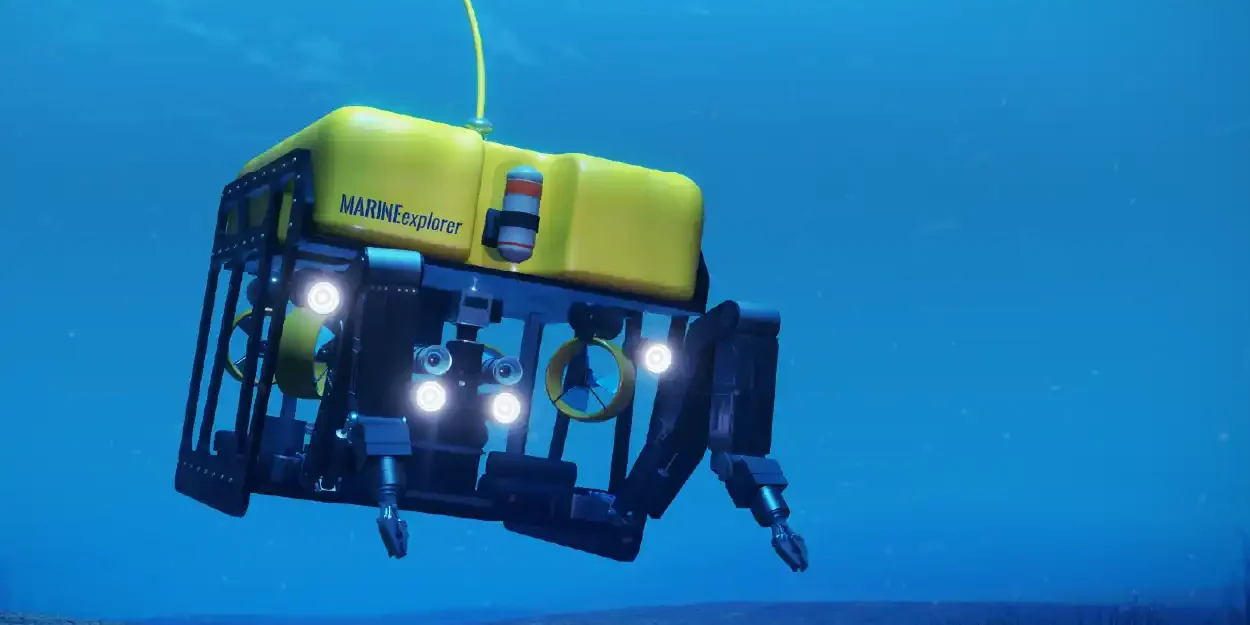
 Selecting the right underwater servo drive for an ROV demands careful evaluation of environmental resilience, power density, and motion control precision. This guide walks you through the critical specifications, drive families, controller architectures, and power supply considerations that determine whether your subsea vehicle will perform reliably at depth.
Key Takeaways
Q: Why can’t standard industrial drives be used as an underwater servo drive ROV solution?
A: Industrial drives lack pressure tolerance, corrosion resistance, compact sizing, and underwater thermal management — all essential for reliable subsea operation.
Q: How does a multi axis controller improve ROV thruster and manipulator coordination?
A: It synchronizes commands across all axes over a single fieldbus, enabling smooth vectored thrust, joint-interpolated arm motion, and centralized diagnostics.
Q: What makes integrated drives and motors beneficial for space-constrained subsea vehicles?
A: Combining the servo amplifier and motor into one unit eliminates extra enclosures, connectors, and cabling — saving weight, space, and reducing potential leak paths.
Q: Why is the Titanium family of drives well-suited for deep-rated underwater servo drive ROV applications?
A: Elmo’s Titanium line is a next-generation product family featuring GaN switching technology and advanced power density in compact form factors. For subsea applications, titanium alloy enclosures (a separate material choice) provide corrosion immunity, high strength-to-weight ratio, and fatigue resistance for housings that must endure full ocean depth pressures and saltwater exposure.
Q: How should engineers size power supplies for an underwater servo drive ROV system?
A: Calculate worst-case simultaneous peak demand across all servo axes, then add a 20–30% margin to cover cable losses, thermal derating, and regenerative energy transients.
Q: Which fieldbus protocol best supports high-performance underwater servo drive ROV architectures?
A: EtherCAT offers sub-millisecond deterministic cycle times and high axis capacity, making it the preferred choice for work-class and heavy work-class ROVs.
Q: How are GaN and SiC semiconductors advancing underwater servo drive ROV power density?
A: Wide-bandgap devices cut switching losses by 30–50%, enabling cooler, smaller drives — a critical advantage inside sealed subsea enclosures with limited thermal dissipation.
The Critical Role of Servo Drives in Modern ROVs
Remotely operated vehicles depend on servo drives to convert electrical commands into precise mechanical motion. Every thruster adjustment, manipulator articulation, and camera pan relies on a servo drive that can deliver accurate torque and speed control under demanding conditions. Without high-performance drives, even the most advanced ROV frame becomes an expensive, uncontrollable hull.
What a Servo Drive Actually Does in an ROV
A servo drive receives position, velocity, or torque commands from a higher-level controller and regulates current to the motor windings accordingly. In an ROV context, this closed-loop control must happen with minimal latency, because operators on the surface need immediate response when navigating around subsea infrastructure or collecting samples.
Why Generic Industrial Drives Fall Short
- Pressure tolerance: Standard industrial servo drives are not rated for external pressures encountered at operational depths of 3,000 m or more.
- Corrosion vulnerability: Exposed connectors and aluminum housings degrade rapidly in saltwater.
- Size and weight: Industrial drives are designed for cabinet mounting, not for fitting inside pressure-compensated pods or flooded compartments.
- Thermal management: Heat dissipation strategies that rely on ambient air fail entirely underwater.
These limitations explain why ROV designers turn to purpose-built solutions from manufacturers like Elmo, whose miniaturized servo drives are engineered to operate in extreme conditions while maintaining full servo performance.
The Performance Chain: Drive, Motor, Controller
A servo drive does not work in isolation. Its effectiveness depends on tight integration with the motor it powers and the controller that issues commands. When selecting an underwater servo drive for an ROV, engineers must evaluate the entire signal and power chain – from the topside control station through the tether to the subsea electronics pod – to ensure compatibility and performance consistency.
Meeting the Challenge of the Underwater Harsh Environment
The subsea world presents a uniquely punishing set of conditions that stress every electronic component aboard an ROV. Understanding these challenges is the first step toward selecting a servo drive that will survive and perform throughout the vehicle’s operational life.
Pressure and Depth Rating
Hydrostatic pressure increases by approximately 1 atmosphere for every 10 meters of depth. At 4,000 m, components face 400 atmospheres of pressure. Servo drives can be housed in pressure-resistant enclosures or designed for operation in pressure-compensated, oil-filled housings. Each approach carries trade-offs in weight, complexity, and thermal behavior.
Saltwater Corrosion
Seawater is an aggressive electrolyte. Any exposed metal surface is subject to galvanic corrosion, crevice corrosion, or stress corrosion cracking. Drives intended for harsh environment operation must use corrosion-resistant materials for housings, connectors, and fasteners. Titanium, marine-grade stainless steel, and specialized polymer encapsulations are common material choices for subsea electronics.
Temperature Extremes and Thermal Cycling
Deep ocean temperatures hover near 2 degrees Celsius, while surface waters in tropical regions can exceed 30 degrees Celsius. A single dive cycle can expose electronics to a 25-degree swing. Repeated thermal cycling fatigues solder joints and connector seals. High-quality servo drives address this through conformal coating, strain-relieved connections, and wide operating temperature ranges.
Biofouling and Long-Term Deployment
- Marine growth: Barnacles, algae, and biofilms can obstruct cooling surfaces and jam connectors on vehicles deployed for extended periods.
- Material selection: Anti-fouling coatings and smooth, crevice-free housing designs reduce biological accumulation.
- Maintenance intervals: Drives with sealed, maintenance-free construction reduce the cost and risk of frequent recovery and servicing.
Key Specifications for Subsea Servo Performance
Choosing the right underwater servo drive for your ROV requires a clear understanding of the electrical and mechanical specifications that govern performance. Below are the parameters that matter most for subsea applications.
Continuous and Peak Current Ratings
The continuous current rating determines how much torque the drive can sustain indefinitely, while the peak current rating defines short-duration burst capability for acceleration or load transients. In ROV applications, manipulator arms frequently demand high peak currents during gripping and lifting, while thrusters require sustained continuous current for station-keeping.
Voltage Range and Bus Compatibility
ROV power distribution architectures vary widely. Some systems deliver 48 VDC to the subsea electronics pod, while larger work-class vehicles may use 300 VDC or higher bus voltages. The selected servo drive must accept the available bus voltage and regulate it efficiently. Elmo offers drives across a broad voltage spectrum, allowing designers to match the drive to the vehicle’s power architecture without intermediate conversion stages.
Bandwidth and Loop Update Rate
| Parameter | Observation-Class ROV | Work-Class ROV | Heavy Work-Class ROV |
| Typical current loop rate | 10 kHz | 20 kHz | 20-40 kHz |
| Position loop rate | 1 kHz | 5 kHz | 5-10 kHz |
| Required bandwidth | Moderate | High | Very high |
| Typical axis count | 3-5 | 8-12 | 12-20+ |
Higher loop update rates translate to smoother motion and faster disturbance rejection, which is critical when ocean currents buffet the vehicle during precision tasks.
Feedback Device Support
- Incremental encoders: Common and cost-effective, but require homing after power loss.
- Absolute encoders: Provide position data immediately on power-up, eliminating homing routines.
- Resolvers: Extremely rugged and well-suited for harsh environment applications where encoder optics may fog or fail.
- Hall sensors: Often used for brushless DC motor commutation in thruster applications.
Ensure the servo drive supports the feedback type used by your motor. Many Elmo drives support multiple feedback protocols simultaneously, providing flexibility during the design phase.
Using a Multi Axis Controller for Coordinated ROV Motion
ROVs are inherently multi-degree-of-freedom machines. A work-class vehicle may have six thrusters, a seven-function manipulator arm, a pan-and-tilt camera unit, and auxiliary tool actuators – all requiring synchronized motion control. A multi axis controller provides the centralized intelligence to coordinate these axes efficiently.
Centralized vs. Distributed Control Architectures
In a centralized architecture, a single multi axis controller generates commands for all servo drives. This simplifies software development and ensures tight synchronization. In a distributed architecture, each drive runs its own motion profile, and a supervisory controller coordinates at a higher level. Many ROV designers adopt a hybrid approach, using a centralized controller for the manipulator arm while running thruster drives in a distributed velocity-control mode.
Benefits of Multi Axis Coordination
- Synchronized thruster vectoring: Coordinated thrust commands enable smooth translational and rotational motion without yaw coupling.
- Arm kinematics: Joint-interpolated and Cartesian-space motion requires simultaneous, tightly timed commands across all arm joints.
- Reduced cabling: A single fieldbus connection between the controller and multiple drives replaces individual command wires for each axis.
- Centralized diagnostics: One controller can monitor current, temperature, and fault status across all axes, simplifying fault isolation.
Fieldbus Protocols for Subsea Networks
EtherCAT has become the dominant fieldbus for high-performance multi axis control due to its deterministic timing and high bandwidth. CANopen remains popular in smaller ROVs where simplicity and lower cable counts are priorities. Elmo’s multi axis controller platforms support both protocols, giving designers the freedom to select the network topology that best fits their vehicle’s architecture and latency requirements.
Why Integrated Drives and Motors Are Ideal for Compact ROVs
Space is one of the most constrained resources on any ROV. Every cubic centimeter inside a pressure housing is contested by electronics, sensors, hydraulic valves, and cabling. Integrated drives and motors address this constraint by combining the servo amplifier and the motor into a single compact unit.
Space and Weight Savings
By mounting the drive electronics directly on or inside the motor housing, designers eliminate a separate drive enclosure, the cable between drive and motor, and the associated connectors. For a seven-axis manipulator arm, this can save hundreds of grams and several centimeters of linear space per joint – a meaningful reduction on a compact observation-class ROV.
Reduced Wiring Complexity
- Fewer connectors: Each underwater connector is a potential leak path. Reducing connector count directly improves reliability.
- Shorter motor cables: Long cables between drive and motor introduce inductance and EMI. Integrated drives and motors eliminate this issue entirely.
- Simplified assembly: Technicians can install a single integrated unit rather than routing and terminating separate power and feedback cables.
Thermal Advantages
When the drive is thermally coupled to the motor housing, heat generated by switching losses in the drive can be conducted into the motor frame and dissipated through the surrounding seawater. This natural convective cooling path is far more effective than relying on conduction through air gaps inside a sealed electronics pod.
Elmo’s Approach to Integration
Elmo has developed ultra-miniature servo drives specifically designed for integration into motor housings. These drives maintain full servo performance – including advanced current, velocity, and position control loops – in a package small enough to fit inside the back end of a NEMA 17 or NEMA 23 motor frame. For ROV designers, this means each actuator becomes a self-contained, intelligent motion module that only needs power and a communication bus connection.
Corrosion Resistance with the Titanium Family of Drives
Material selection for subsea electronics housings directly impacts operational lifespan and maintenance costs. Titanium alloys have long been the material of choice for critical subsea components due to their exceptional strength-to-weight ratio and near-immunity to seawater corrosion.
Why Titanium for Servo Drive Housings
- Corrosion resistance: Titanium forms a stable oxide layer that resists attack by chloride ions in seawater, even at elevated temperatures.
- High strength at low weight: Titanium is roughly 45% lighter than steel at comparable strength, reducing overall vehicle buoyancy trim requirements.
- Biocompatibility: The oxide layer also resists biofouling adhesion more effectively than many alternative metals.
- Fatigue resistance: Titanium withstands repeated pressure cycling without the fatigue cracking that can affect aluminum alloys.
The Elmo Titanium Family
Elmo’s Titanium line is a product family name — like Gold and Platinum — not a reference to housing material. These next-generation drives deliver high power density in extremely compact form factors and incorporate GaN switching technology, making them well-suited for demanding applications including subsea enclosures where space is at a premium. The Titanium line supports a wide range of motor types — including brushless DC, DC brush, stepper, and linear motors — giving ROV designers flexibility in actuator selection. For subsea housings that require actual titanium enclosure material, this is a separate mechanical design consideration independent of the drive product line selected.
Matching Drive Housing to Vehicle Design
Not every ROV requires titanium-grade housings. The table below helps match housing material to operational requirements:
| Housing Material | Max Depth Rating | Corrosion Resistance | Relative Cost | Best Suited For |
| Anodized aluminum | 300 m | Moderate | Low | Shallow inspection ROVs |
| 316L stainless steel | 3,000 m | Good | Medium | Mid-depth work-class ROVs |
| Titanium Grade 5 | 6,000 m+ | Excellent | High | Full ocean depth vehicles |
| Polymer/composite | 1,000 m | Excellent | Medium | Observation-class ROVs |
Comparing Servo Drive Tiers: From Gold to Platinum
Elmo organizes its servo drive product lines into distinct tiers, each targeting different performance and application requirements. Understanding these tiers helps ROV designers select the right balance of capability, size, and cost for their specific vehicle class.
Gold Series
The Gold series has been a long-standing workhorse in Elmo’s lineup. Gold drives offer reliable servo performance with support for multiple feedback types, configurable I/O, and network connectivity via both EtherCAT and CANopen. They are well-suited for ROV applications where proven reliability matters more than achieving the absolute smallest form factor. Many existing work-class ROVs in the field use Gold-series drives in their manipulator and thruster control systems.
Platinum Series
The Platinum series represents Elmo’s highest-performance tier. These drives feature faster control loop execution, higher current density, and advanced safety functions. Key advantages for ROV applications include:
- Ultra-high current loop rates: Up to 40 kHz for precise torque control in dynamic conditions.
- EtherCAT support: Deterministic communication for tightly synchronized multi axis control.
- STO (Safe Torque Off): Hardware-level safety function for emergency shutdown of actuators.
- Compact footprint: Higher integration density reduces the size of subsea electronics pods.
Selecting the Right Tier for Your ROV
For a small observation-class ROV with three to five axes, a Gold-series drive may provide all the performance needed at a lower cost point. For a heavy work-class vehicle with 15+ axes, high-speed manipulator requirements, and EtherCAT networking, the Platinum series delivers the bandwidth and synchronization precision the application demands. The choice should be driven by the vehicle’s operational requirements, not by specification maximization for its own sake.
Choosing Robust Power Supplies for Deep Sea Operations
The servo drive is only as reliable as the power it receives. Selecting appropriate power supplies for an ROV’s subsea electronics is a critical but often underestimated part of the system design process.
Topside vs. Subsea Power Conversion
Most ROVs receive high-voltage AC or DC power through the tether and convert it to the required bus voltages at the subsea end. This approach minimizes tether conductor size and I-squared-R losses over long cable runs. The subsea power supply must handle the conversion efficiently while withstanding pressure, temperature, and vibration.
Key Power Supply Specifications
- Input voltage range: Must accommodate voltage drops across tethers of varying length, typically 10-15% below nominal.
- Output regulation: Servo drives require stable DC bus voltage. Ripple and transient specifications must be within the drive’s input tolerance.
- Efficiency: Every watt lost as heat inside a sealed enclosure raises internal temperature. Power supplies with 90%+ efficiency reduce thermal management burden.
- Isolation: Galvanic isolation between the tether supply and the drive bus prevents ground loops and protects against tether faults.
- Redundancy: Mission-critical ROVs often use N+1 redundant power supplies to maintain operation if one unit fails.
Sizing Power Supplies for Servo Loads
Servo drives present dynamic loads with high peak-to-average power ratios. A manipulator arm that draws 200 W continuously may demand 1,500 W during a fast joint acceleration. The power supply must handle these transients without voltage sag. Designers should calculate the worst-case simultaneous peak demand across all axes, then add a 20-30% margin to account for cable losses and component derating at temperature.
Regenerative Energy Considerations
When a servo drive decelerates a motor, kinetic energy flows back into the DC bus. If the power supply cannot absorb regenerative energy, bus voltage rises and may trigger overvoltage faults. Solutions include shunt regulators (which dissipate excess energy as heat), bus capacitor banks (which buffer transient energy), and bidirectional power supplies that can return energy to the tether. For ROVs with large inertial loads on manipulator joints, regenerative energy management is a design requirement rather than an afterthought.
Integration with ROV Control and Telemetry Systems
An underwater servo drive for an ROV does not operate in isolation. It must communicate with the vehicle’s supervisory control system, accept commands from the surface operator, and report status data through the telemetry link. Successful integration depends on protocol compatibility, timing discipline, and robust error handling.
Control System Architecture
A typical ROV control architecture includes a topside control console, a tether management system, a subsea telemetry unit, and one or more subsea processors that interface with servo drives and sensors. The servo drive sits at the lowest level of this hierarchy, executing motion commands issued by the subsea processor.
Communication Protocol Selection
| Protocol | Cycle Time | Axis Capacity | Cable Type | ROV Suitability |
| EtherCAT | Less than 1 ms | 100+ | Ethernet (Cat5e/Cat6) | Excellent for work-class |
| CANopen | 1-10 ms | 127 | Twisted pair | Good for observation-class |
| RS-485/Modbus | 10-100 ms | 32 | Twisted pair | Adequate for simple tools |
| Ethernet/IP | 1-10 ms | 100+ | Ethernet | Good, less deterministic |
Telemetry Bandwidth Allocation
ROV tethers carry video, sonar, sensor data, and control commands through a shared communication link. Servo drive telemetry – position feedback, current readings, temperature, and fault codes – competes for bandwidth with high-priority video streams. Efficient drives minimize telemetry overhead by using compact data frames and event-driven fault reporting rather than continuous status polling.
Fault Handling and Recovery
- Communication loss: The drive should enter a safe state (e.g., controlled stop or zero torque) if it loses contact with the controller for a configurable timeout period.
- Overcurrent protection: Hardware-level current limiting prevents motor and drive damage during stall conditions or mechanical jams.
- Thermal derating: The drive should automatically reduce output current as internal temperature approaches limits, rather than shutting down abruptly.
- Fault logging: Non-volatile fault logs allow post-dive analysis of anomalies, supporting predictive maintenance programs.
Future-Proofing Your Design: What’s Next for ROV Servos in 2026
The subsea robotics industry continues to advance, driven by growing demand for offshore energy infrastructure inspection, deep-sea mining exploration, and scientific research at extreme depths. ROV servo technology is evolving to meet these expanding requirements.
Higher Power Density Through GaN and SiC
Gallium nitride (GaN) and silicon carbide (SiC) power semiconductors are enabling servo drives that switch faster, run cooler, and pack more power into smaller volumes. These wide-bandgap devices reduce switching losses by 30–50% compared to traditional silicon MOSFETs, depending on operating conditions and voltage range, directly benefiting ROV applications where thermal management inside sealed enclosures is a constant challenge. Elmo has been incorporating advanced semiconductor technologies into its drive platforms to push power density boundaries further.
AI-Assisted Motion Control
Machine learning algorithms are beginning to appear in ROV control systems, enabling features such as adaptive thruster compensation for changing current conditions, predictive maintenance based on motor current signatures, and autonomous manipulation task planning. Servo drives that support high-speed data streaming and onboard processing will be better positioned to participate in these AI-augmented control loops.
Standardization of Subsea Interfaces
- Subsea ethernet standards: Industry groups are working toward standardized high-speed ethernet interfaces for subsea equipment, which will simplify integration of servo drives from different manufacturers.
- Modular tool interfaces: Standardized electrical and mechanical interfaces for ROV tooling will allow servo-driven tools to be swapped between vehicles without custom integration work.
- Digital twin integration: Real-time servo drive data feeds into digital twin models of the ROV, enabling operators to monitor component health and predict remaining useful life from the surface.
Deeper Depth Ratings and Extended Autonomy
As hybrid ROV-AUV vehicles gain traction, servo drives must operate reliably during extended autonomous missions lasting days or weeks without surface support. This places new demands on power efficiency, fault tolerance, and self-diagnostic capability. Drives that can autonomously detect degradation in motor insulation, bearing wear, or connector integrity – and adjust their operating parameters accordingly – will become essential components of next-generation subsea vehicles.
Selecting a Technology Partner
When evaluating servo drive suppliers for a new ROV design, consider not only the current product specifications but also the manufacturer’s roadmap and commitment to the subsea market. Elmo’s track record of miniaturization, high power density, and support for harsh environment applications positions it as a strong partner for ROV programs that need to remain competitive through 2026 and beyond. The right underwater servo drive ROV selection today should account for the missions, depths, and autonomy levels your vehicle will face over its full operational lifespan.