



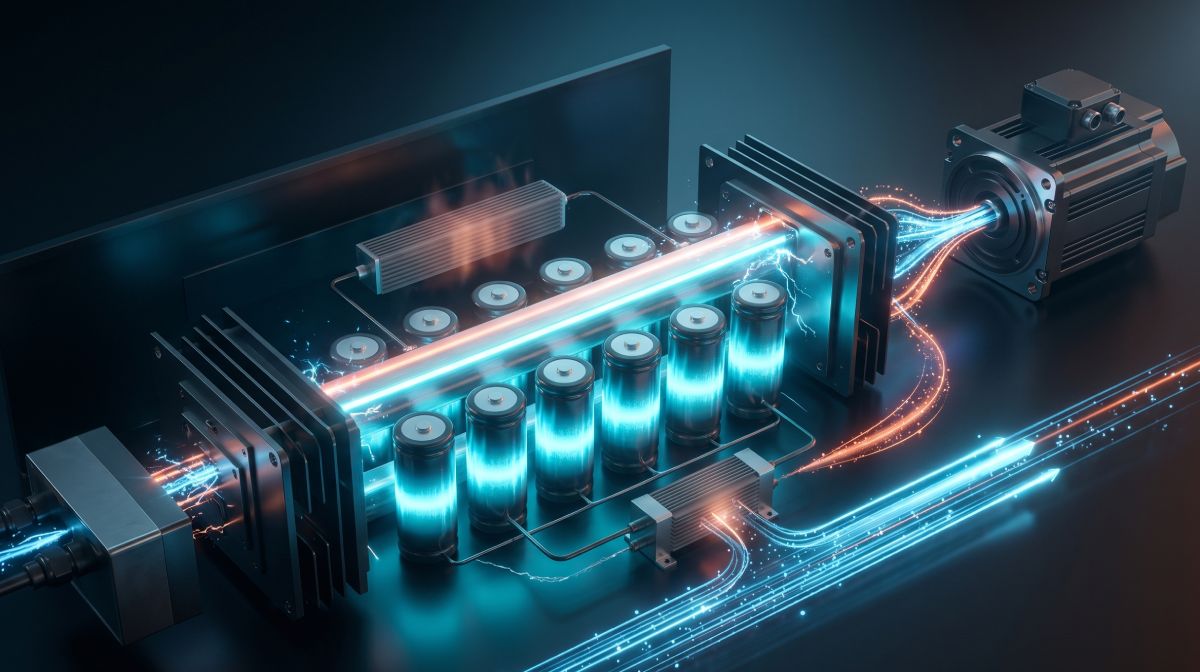
 When engineers specify servo drive solutions, the focus almost instinctively goes to motor power, torque curves, and the physical footprint of the drive. The DC bus, however, is often the hidden factor that truly determines real-world performance, braking capability, and long-term reliability.
The reality on the factory floor is that the exact same hardware can behave completely differently depending on how well the DC bus is designed and managed. It operates as the central energy reservoir and power highway in every servo drive solution governing how energy flows in, how it is stored, and how cleanly it is delivered to the motor at every millisecond of the machine cycle.
Key Takeaways
- The DC bus is the energy reservoir and power highway of every servo drive solution.
- Correct DC bus voltage and bus capacitance directly control regeneration and smoothness.
- Shunt resistors are protection devices – not the main energy management method.
- Proper DC bus design prevents overvoltage faults and dramatically extends machine life.
What the DC Bus Actually Does Inside a Servo Drive Solution
In a standard servo architecture, incoming AC power enters the drive and is immediately converted into direct current (DC) by a rectifier stage. This newly created DC power sits on the DC bus a low-impedance internal power rail that feeds the drive’s inverter section. The inverter then draws from this bus to reconstruct precise, variable-frequency power that goes out to the servo motor.
The DC bus in a servo drive acts as the critical intermediary between two very different electrical worlds. On one side is the noisy, fluctuating AC line. On the other side is the highly controlled power environment required for precise motion. The bus separates these two domains, acting as a buffer that absorbs supply-side disturbances before they can reach the motor control stage.
Beyond simple power delivery, the DC bus is also where energy flows in both directions. During acceleration, energy moves from the bus to the motor. During deceleration, the motor acts as a generator and pushes energy back onto the bus. How the drive manages that returning energy determines whether the machine trips, wastes energy as heat, or recovers it intelligently.
Energy flow diagram – AC input -> Rectifier -> DC Bus -> Inverter -> Servo Motor, with regenerative return path shown from Motor back to DC Bus.
DC Bus Voltage Explained – From Rectifier to Motor
Understanding DC bus voltage is fundamental to modern machine design. The nominal bus voltage is set by the incoming AC supply. When standard 480V AC three-phase power is rectified by a six-pulse rectifier, the resulting nominal DC bus voltage naturally sits around 680V DC. For 400V AC systems common in European and Asian markets, the nominal DC bus voltage is approximately 565V DC.
This voltage is never completely static. When the motor accelerates under a heavy load, the bus voltage dips momentarily as stored energy is rapidly consumed. The bus capacitors partially compensate for this dip, but a deep voltage drop can cause the drive to fault if it falls below the undervoltage threshold.
Conversely, when the motor decelerates, it transitions into generator mode. Kinetic energy from the load returns through the motor windings and back into the DC bus, pushing the voltage upward. If this rise exceeds the drive’s overvoltage trip threshold typically 10 to 15 percent above the nominal DC bus voltage the drive will fault immediately to protect its internal components.
Managing this dynamic bus voltage behaviour is not just about protection. Tight voltage regulation across the entire motion cycle also directly improves torque linearity and position accuracy, since the inverter’s output is referenced to bus voltage at every switching cycle.
Voltage waveform chart DC bus voltage over time during a trapezoidal move profile: dip during acceleration ramp, stable at constant velocity, rise during deceleration ramp, with overvoltage and undervoltage trip thresholds shown.
Bus Capacitors vs Shunt Resistors – Roles and Trade-offs
Every DC bus relies on bus capacitance to smooth out voltage ripple and store energy locally. Capacitors act like electrical shock absorbers. They handle the micro-fluctuations in DC bus voltage caused by rectifier switching and absorb the immediate, small amounts of regenerative energy produced during standard deceleration cycles.
Bus capacitors are also the first line of defense against instantaneous bus voltage spikes. Large capacitance values provide greater ride-through energy during momentary AC line dips and allow the drive to continue operating through brief supply interruptions.
However, bus capacitors have strict physical limits. If a large, high-inertia load stops quickly, the capacitors will charge to their maximum rated voltage before all the regenerative energy has been absorbed. At that point, the drive requires a secondary mechanism to prevent overvoltage.
This is where the shunt resistor comes in. A shunt resistor also known as a braking resistor or dynamic braking resistor is a fast-acting protection device that connects across the DC bus through a switching transistor. When bus voltage reaches a defined threshold, the transistor activates and routes excess regenerative energy through the resistor, where it is safely dissipated as heat.
The critical distinction is this: bus capacitors manage normal energy fluctuations continuously and passively. Shunt resistors handle exceptional energy events reactively. Treating a shunt resistor as the primary energy management strategy rather than a safety backstop is a common design mistake that leads to resistor overheating and premature failure.
How to Correctly Size DC Bus Capacitance and Shunt Resistors
Sizing DC bus components correctly requires calculating the actual kinetic energy of the mechanical system, not just selecting components based on motor nameplate power. The governing formula is:
E = ½ × J × ω²
Where E is kinetic energy in joules, J is total system inertia in kg·m² (motor rotor plus load reflected through the gearbox), and ω is the angular velocity in radians per second at the start of the deceleration.
From this number, subtract the energy absorbed by motor winding resistance during deceleration (typically 10–20 percent of total kinetic energy for high-efficiency motors) and the energy that can safely be absorbed by the existing bus capacitance without exceeding the overvoltage threshold. The remaining energy defines the required capacity of the shunt resistor.
For shunt resistor sizing, engineers must evaluate two separate ratings. The peak power rating must handle the maximum instantaneous regenerative power during the fastest possible deceleration. The continuous wattage rating must handle the average thermal load across the full duty cycle including how frequently the machine stops and how long the resistor has to cool between braking events.
Under-sizing the peak rating causes the resistor to fail catastrophically during a single hard stop. Under-sizing the continuous rating causes gradual thermal degradation and eventual failure after hours or days of normal operation, which is far harder to diagnose in the field.
Shunt Resistor vs Regenerative Braking – When to Use Each
For machines with occasional rapid stops such as indexing tables, pick-and-place systems, or packaging feeders a properly sized shunt resistor is the most cost-effective and mechanically straightforward solution. The excess kinetic energy is burned off safely as heat, and the total cost and wiring complexity remain low.
The decision changes fundamentally when deceleration events are frequent, continuous, or involve very high inertia loads. In these applications, the thermal energy dissipated through the shunt resistor becomes a significant heat source inside or adjacent to the control cabinet. Large resistors require dedicated heat sinking, ventilation, or even external mounting all of which add cost and engineering overhead.
For applications involving continuous, high-inertia deceleration such as large centrifuges, wire drawing machines, or continuous web handling lines regenerative braking is vastly superior. An active front end or regenerative power supply for servo applications actively inverts the returned DC energy back into AC and pushes it onto the power grid. This eliminates braking resistor heat entirely, reduces cabinet thermal load, and can meaningfully reduce energy costs in high-duty-cycle applications.
The practical crossover point depends on total regenerated energy per hour. Applications regenerating more than a few kilowatt-hours per shift typically justify the additional upfront investment in a regenerative front end on energy savings alone, before accounting for reduced cooling infrastructure.
Real-World DC Bus Failures and How to Prevent Them
The most common unplanned faults in servo drive solutions are directly tied to DC bus behavior. Consistent overvoltage faults during deceleration almost always point to insufficient bus capacitance, an undersized or failed shunt resistor, or a deceleration ramp that is shorter than the mechanical system can physically support.
Undervoltage faults during acceleration typically indicate that the power supply for servo motor systems is undersized for the peak demand of the application, or that the AC supply itself has significant line impedance that causes excessive voltage drop under load.
A subtler failure mode is gradual bus capacitor degradation. Electrolytic capacitors age over time, losing capacitance and increasing equivalent series resistance. This manifests as increasing DC bus voltage ripple, which stresses the switching transistors in the inverter and accelerates their aging in turn. Drives in high-cycle applications should have their bus capacitor condition monitored or proactively replaced according to the manufacturer’s service interval.
Preventing these failures requires specifying a drive with adequate internal DC bus capacitance for the application duty cycle, selecting shunt resistors with the correct peak and continuous ratings, and ensuring the incoming power supply for servo motor setups is matched to actual peak power demand not just continuous rated power.
Best Practices for Multi-Axis and Common DC Bus Systems
In automation machines with multiple servo axes robotic arms, multi-axis gantries, coordinated packaging lines moving to a common DC bus architecture is one of the highest-impact design decisions available. Instead of each drive managing its own independent power budget and braking events, all drives share a single DC power highway.
The energy-sharing benefit is significant. If one axis decelerates while another simultaneously accelerates, the common DC bus transfers that regenerated energy directly to the accelerating axis without it ever touching the AC line or the braking resistor. This reduces instantaneous peak demand on the external power supply for servo motor systems and minimizes the required capacity of shunt resistors across the entire machine.
Common DC bus systems also simplify cabinet wiring and reduce the total component count. A single shared bus capacitor bank, a single shared shunt resistor or regenerative unit, and a single power supply replace the individual components that each stand-alone drive would otherwise require.
The main design consideration in a common DC bus system is protection coordination. A hard fault on any single axis such as a short-circuit event can rapidly discharge the shared bus and affect all connected axes simultaneously. Each drive must be properly fused or protected with fast-acting current limiting to isolate a faulted axis without cascading the failure across the system.
Architecture diagram Common DC Bus topology: single AC input -> shared rectifier/power supply -> shared DC Bus rail -> individual drive inverter modules for each servo axis, with shared shunt resistor shown across the bus.
Conclusion – Why Getting the DC Bus Right Is One of the Smartest Decisions in Any Servo Drive Solution
The DC bus is far more than a passive link between the rectifier and the inverter. It dictates how fast a machine can cycle, how well it handles sudden stops, how efficiently it utilizes power, and how long the drive electronics will survive in continuous operation.
Engineers who treat the DC bus as an afterthought selecting bus capacitance and shunt resistors from a default BOM without analyzing the actual load profile are building in a hidden margin of failure. By carefully evaluating DC bus voltage behavior, properly sizing bus capacitance for the application duty cycle, selecting shunt resistors based on actual kinetic energy calculations, and considering common DC bus architectures in multi-axis systems, engineers can build automation systems that run faster, cooler, and without unexpected downtime.
The DC bus is where hardware performance meets energy physics. Getting it right is not optional it is the foundation of a reliable servo drive solution.
Frequently Asked Questions
What is the DC bus in a servo drive and why is it important?
The DC bus is the internal direct current power rail between the drive’s rectifier and its inverter section. It stores energy, smooths voltage ripple, and manages regenerative power from the motor during deceleration. Its design directly determines machine performance, braking reliability, and drive longevity.
What is DC bus voltage and how is it determined?
DC bus voltage is the rectified DC voltage present on the internal bus. It is primarily set by the incoming AC supply voltage 480V AC produces approximately 680V DC, and 400V AC produces approximately 565V DC. The actual bus voltage fluctuates dynamically during acceleration and deceleration, and managing these swings within safe limits is a core part of drive design.
What are bus capacitors used for in servo drive solutions?
Bus capacitors smooth the voltage ripple produced by the rectifier, provide short-term energy storage to support peak motor demand, and absorb modest amounts of regenerative energy during deceleration. They are passive, continuous-duty components that operate on every machine cycle.
How do I calculate and size a shunt resistor?
Start by calculating total system kinetic energy using E = ½ × J × ω². Subtract energy absorbed by motor losses and bus capacitance. The remaining value defines the required resistor energy capacity. Then determine peak regenerative power for the pulse rating, and average power across the duty cycle for the continuous wattage rating. Both values must be met independently.
What is the difference between a shunt resistor and regenerative braking?
A shunt resistor dissipates excess regenerative energy as heat to prevent overvoltage on the DC bus. Regenerative braking uses an active front end to convert that energy back to AC and return it to the power grid. Shunt resistors are simpler and cost-effective for occasional braking; regenerative solutions are preferred for high-duty-cycle or high-inertia applications where heat dissipation becomes a limiting factor.
Can an undersized DC bus cause machine failures?
Yes. Insufficient bus capacitance leads to frequent overvoltage trips during deceleration and increased voltage ripple that degrades inverter components over time. An undersized shunt resistor will overheat and fail, removing overvoltage protection entirely. Both failure modes result in unplanned downtime and can shorten drive service life significantly.
How does a common DC bus work in multi-axis systems?
A common DC bus connects the DC links of multiple servo drives to a shared power rail. Drives that are decelerating generate power that is immediately available to drives that are accelerating, without going through the AC supply or the braking resistors. This improves energy efficiency, reduces peak power demand, and allows the use of a single shared braking or regenerative unit for the entire machine.